Updated for 2026: FANUC CRX-30iA (30 kg), ABB PoWa (30 kg, 5.8 m/s), and where industrial robots still win — with 6 use-case verdicts.
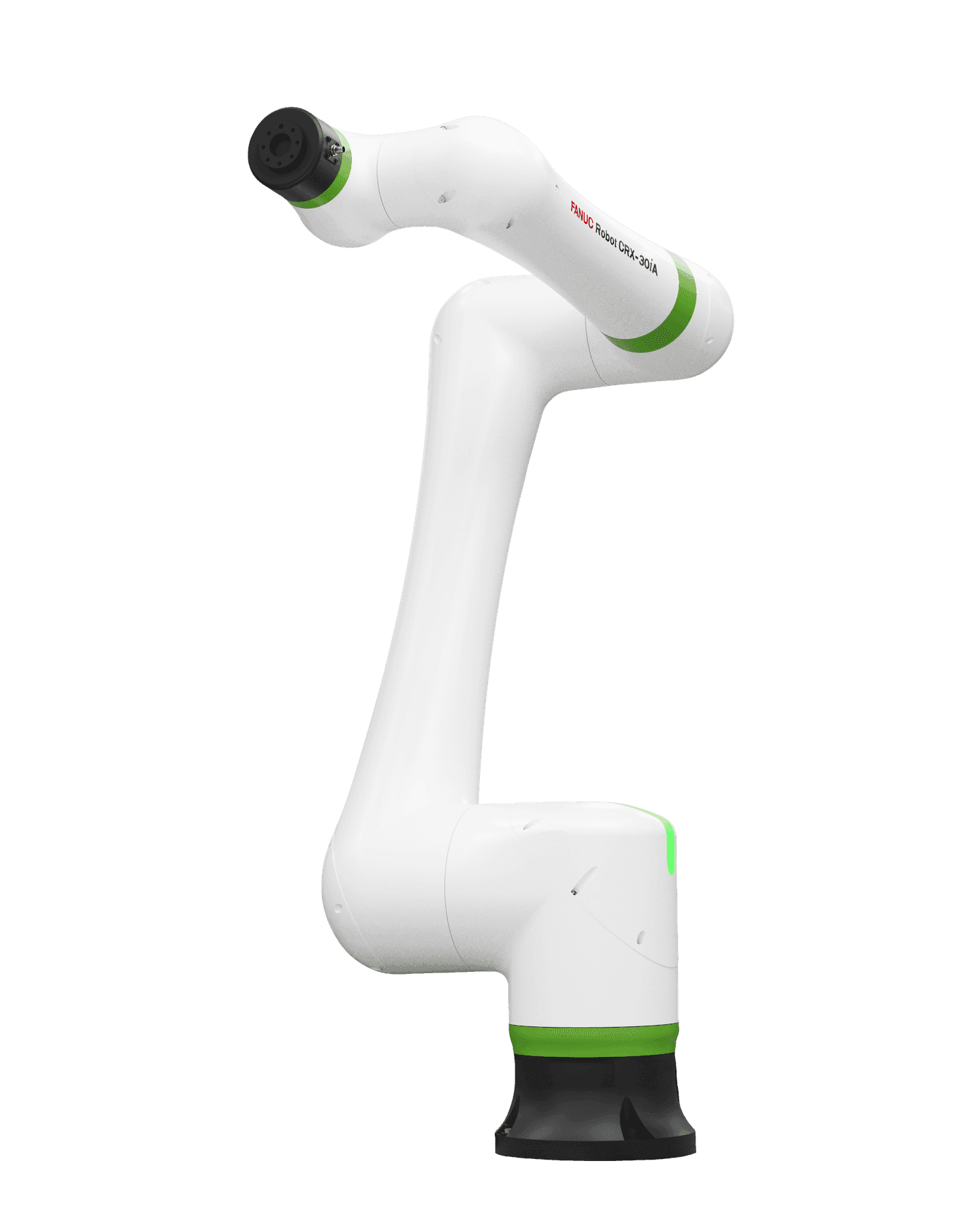
The cobot market has matured dramatically. In 2024, the heaviest production cobot was 25kg. By mid-2026, FANUC's CRX-30iA delivers 30kg at 1,756mm reach (1,889mm at the flange), and ABB's brand-new PoWa family (launched April 2026) covers 7–30kg at a class-leading 5.8m/s TCP speed. The old rule — "cobots top out at 15kg, anything heavier needs an industrial robot" — is no longer accurate. This guide reflects the current hardware landscape and gives you a precise decision framework.
The 2026 Cobot Payload Landscape
Current high-payload cobot options (30kg class):
- FANUC CRX-30iA — 30kg payload, 1,756mm reach, ±0.05mm repeatability, IP67, 8-year maintenance-free. Best for palletizing up to full EUR pallet height.
- FANUC CR-35iA — 35kg payload, 1,813mm reach. Note: this is the older CR series (not CRX) — yellow arm, launched 2015, different controller. Still in production for heavy collaborative tasks above 30kg.
- ABB PoWa 30 — 30kg payload, up to 5.8m/s TCP speed, OmniCore controller. Launched April 2026. Fastest cobot at this payload class — purpose-built for high-speed palletizing and machine tending.
- ABB GoFa 12 (CRB 15000) — 12kg payload, 1,270mm reach, ±0.02mm repeatability. Best-in-class precision for light assembly, inspection, and tending.
- Universal Robots UR20 — 20kg payload, 1,750mm reach. Strong ecosystem, EtherNet/IP native.
Key correction: ABB GoFa does not have a 30kg variant. GoFa tops out at 12kg. ABB's 30kg cobot is the PoWa — an entirely different product line with a different controller (OmniCore vs GoFa's proprietary controller). If a vendor quotes you "ABB GoFa 30kg," walk away.
When Cobots Win
Choose a cobot when:
- No fencing budget or space — cobots operate in shared workspaces under ISO/TS 15066 Power and Force Limiting (PFL) mode without hard guarding
- Payload under 30kg (2026 threshold) — FANUC CRX-30iA and ABB PoWa 30 now cover bags, cartons, and most palletizing applications
- Frequent SKU changeover — operators retrain a cobot pattern in 20–60 minutes via touch-screen teach; industrial robot reprogramming takes hours
- Single-shift or inconsistent operation — cobots are trivially redeployable; industrial robots justify their cost only on high-utilization lines
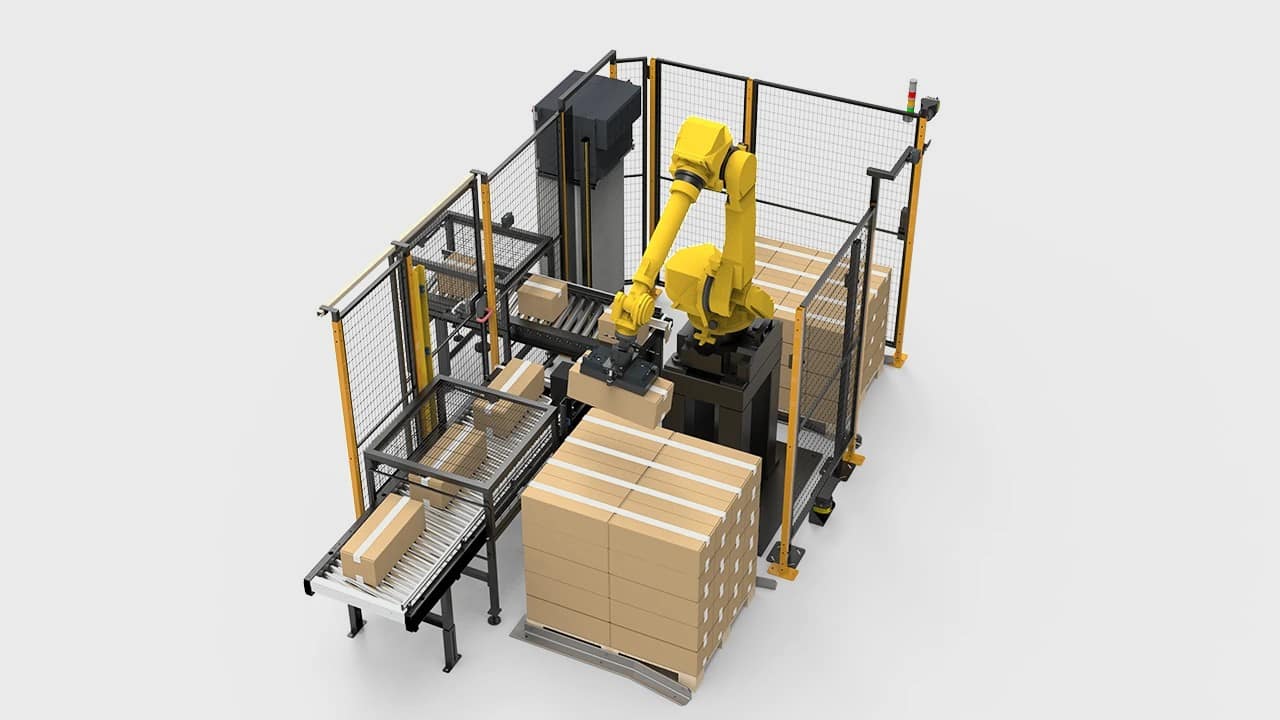
- Limited floor space — a cobot cell including gripper and pallet space fits in 4–6m²; a full industrial palletizing cell needs 15–25m²
When Industrial Robots Win
Choose an industrial robot when:
- Payload above 35kg — no cobot covers this range; FANUC R-2000iC/210F handles 210kg
- Cycle time is critical — at equal payload, industrial robots run 3–5x faster; a cobot palletizer at 8–15 CPH vs. 40–80 CPH on a dedicated industrial palletizer
- Continuous 3-shift high-volume production — industrial robots are rated for higher duty cycles and have more predictable MTBF at sustained speed
- Arc or spot welding — welding duty cycle, torch angle consistency, and speed requirements exceed cobot capability
- High-precision machining or press-fitting — industrial robots with external force feedback achieve better path accuracy at high force
- Explosive or classified environments — cobots lack ATEX/IECEx certification for hazardous areas
6 Use-Case Verdicts — Updated for 2026
Accurate verdicts by application:
- Screwdriving / light assembly (under 5kg): cobot ✅ — ABB GoFa 5 or FANUC CRX-5iA. Operator proximity, easy reprogramming, no fencing.
- Bag palletizing — 25kg bags, 6–10 bags/min: cobot ✅ (2026 update) — FANUC CRX-30iA handles this at full EUR pallet height. No longer requires industrial robot for this payload.
- Bag palletizing — 40kg+ sacks or 300+ bags/hour: industrial robot ✅ — FANUC R-2000iC/165F or ABB IRB 6700. Speed and payload exceed cobot range.
- Machine vision quality inspection: cobot ✅ — low force, repositionable, no fencing. ABB GoFa 12 with ±0.02mm repeatability is ideal.
- Arc welding (MIG/TIG): industrial robot ✅ — speed, continuous duty cycle, and precise torch angle are non-negotiable. ABB IRB 1520ID or FANUC Arc Mate.
- CNC machine tending (under 12kg part): either — cobot if the cell changes often; FANUC CRX-10iA/L or CRX-20iA/L. Industrial robot if cycle time under 25 seconds.
Safety Standard — The Real Difference
Cobots are certified under ISO/TS 15066 with Power and Force Limiting (PFL) sensors on every axis. This means the arm physically cannot injure a person at collaborative speed — it stops on contact. Industrial robots rely on external safeguarding (light curtains, laser scanners, fencing) to keep people out. Both require a formal risk assessment under EN ISO 12100 — but the cobot's PFL mode eliminates the need for hard guarding when operating in fully collaborative mode. Note: once a cobot runs in high-speed mode (not collaborative), the same safety rules as industrial robots apply.
TCO: 5-Year Cost Comparison
Cobot TCO advantage: no fencing (save ₪30,000–60,000), simpler CE engineering, faster installation. Disadvantage: higher cost-per-pick at scale because of lower speed. Break-even: if a cobot runs at 70%+ of an industrial robot's throughput for your application, the cobot wins on TCO in under 5 years. If throughput gap is larger, the industrial robot pays back faster on a 3-shift line. Always model both options with your actual cycle time before deciding.
Xpert Robotics provides free ROI analysis comparing FANUC CRX-30iA cobot vs FANUC R-2000iC industrial robot for your specific application — same day. Contact us or use the ROI Calculator on our website.