Cobot palletizing in 2026 — FANUC CRX-30iA vs ABB GoFa 12, real ROI numbers, CE safety requirements, and how to choose an integrator in Israel.
Cobot palletizing has become one of the most requested automation solutions in Israeli manufacturing. Small and mid-size operations — bakeries, beverage plants, cleaning-product manufacturers, spare-parts suppliers — do not need a 15 m² fenced robot cell. They need a machine that works next to an operator, stops on contact, can be reprogrammed in hours, and pays back the investment in 6–12 months.
What Exactly Is a Cobot Palletizer?
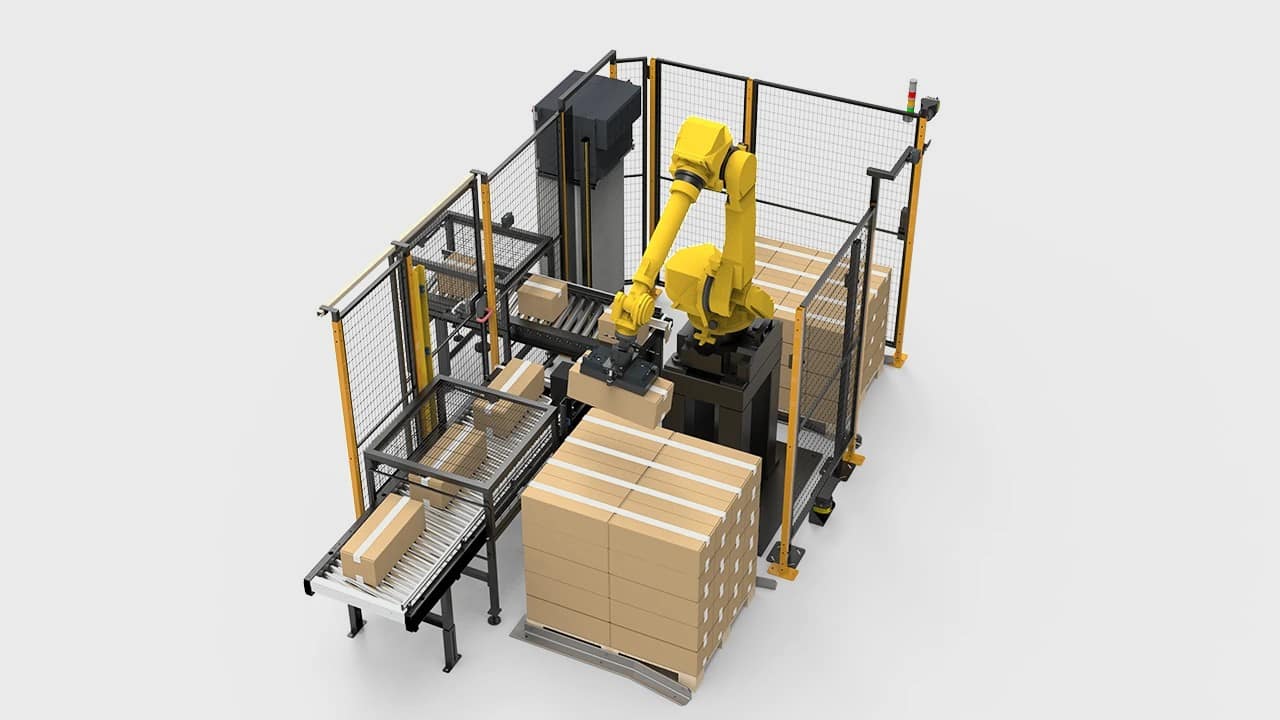
A cobot (Collaborative Robot) is an industrial robot designed from the ground up for shared workspace with humans — no physical guarding required. A cobot palletizer is a cobot fitted with a dedicated end-effector — typically a vacuum cup, clamp gripper, or hybrid — that executes lift, rotate, and layer-stacking cycles onto a logistics pallet. Unlike a classical industrial palletizer running 100+ cycles per hour, a cobot palletizer targets 6–15 pallet layers per hour, which matches the output of most Israeli production lines.
Cobot vs Industrial Palletizer: The Real Difference
Full comparison:
- Safety — Cobot: torque sensors in every joint, auto-stop on contact; Industrial: mandatory fence, light curtain or laser scanner
- Floor space — Cobot: ≤4 m² including gripper; Industrial: 15–25 m² for a complete cell
- Deployment time — Cobot: 1–3 days (graphical teach); Industrial: 2–6 weeks
- Total cost (TCO) — Cobot: $50k–$90k; Industrial: $110k–$250k
- Rate (CPH) — Cobot: 6–15; Industrial: 30–120
- Flexibility — Cobot: new product in hours; Industrial: full reprogramming required
The takeaway: a cobot palletizer is not a replacement for an industrial palletizer — they solve different problems. If your line runs a single SKU at very high volume, an industrial robot with a conveyor may be more cost-effective. If you have 3–8 different SKUs, irregular shift patterns, and limited floor space — a cobot palletizer is the right choice.
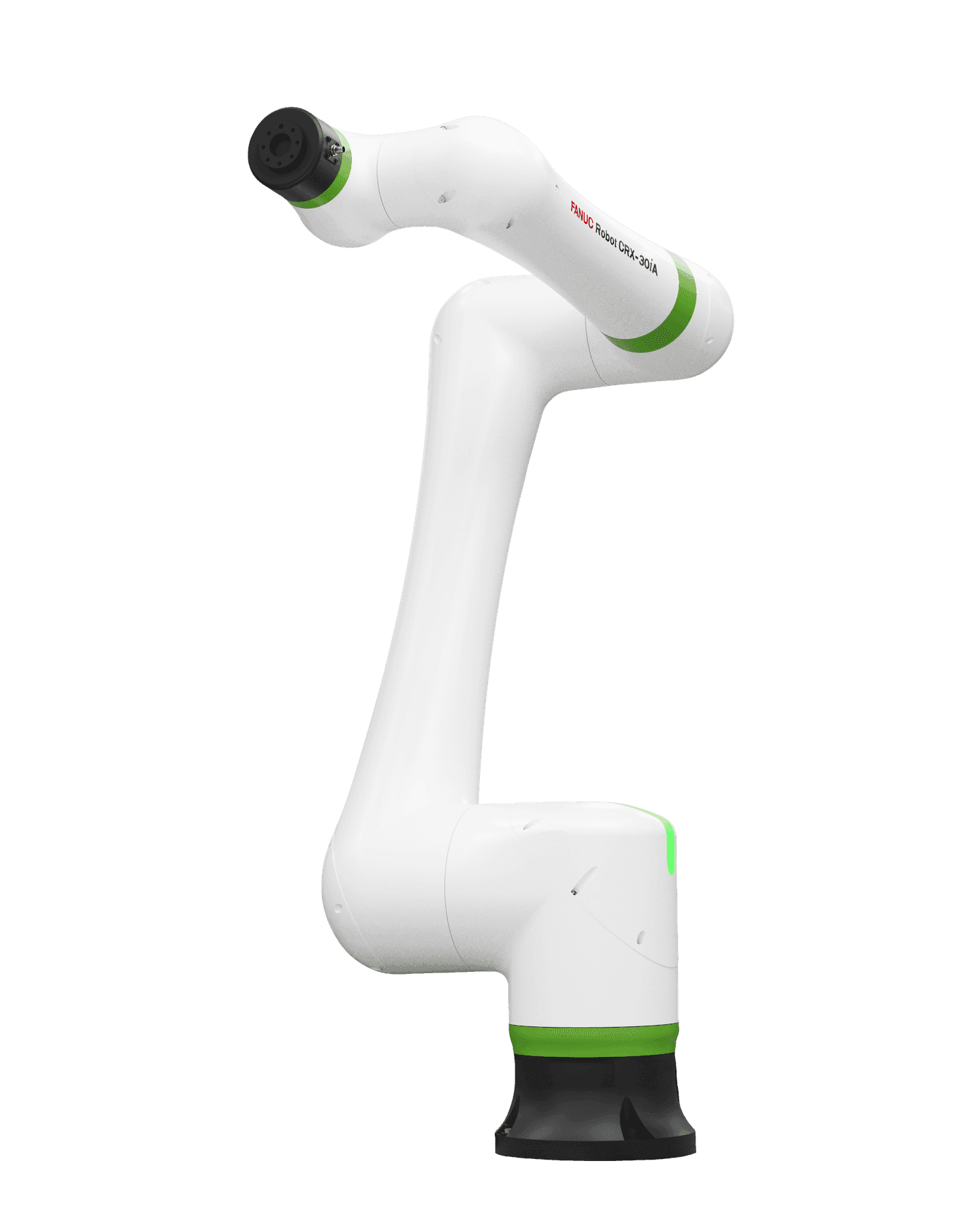
FANUC CRX-30iA: The Most Common Palletizing Cobot in Israel
FANUC CRX-30iA delivers a 30 kg payload and 1,756 mm reach (1,889 mm at the flange) — enough to cover a full EURO pallet (1,200×800 mm) and stack to 2.1 m. What sets it apart: the CRX Touch interface — a 4K touchscreen with drag-and-drop teach that requires zero TP programming knowledge. An operator who was on a manual packing line yesterday can learn a new layer pattern in 20 minutes.
FANUC CRX-30iA specs:
- Payload: 30 kg
- Reach: 1,756 mm (1,889 mm at end of flange)
- Repeatability: ±0.05 mm
- Safety standard: ISO/TS 15066, Power and Force Limiting (PFL)
- IP rating: IP67 (dust and water resistant — suitable for food and beverage lines)
- Connectivity: EtherNet/IP, PROFINET, DeviceNet
- Arm weight: 78 kg — mobile-pedestal mountable
ABB GoFa 12: The Alternative for Faster Lines
ABB GoFa 12 offers only 12 kg payload but significantly higher axis speed — up to 2.2 m/s — allowing 15–18 pallet layers per hour with small cartons. If your product weighs under 10 kg per unit and you produce at roughly one carton every 3–4 minutes, GoFa will achieve faster ROI than CRX-30iA. Both models are compatible with ABB SafeMove2 for software-defined safety zones and advanced speed monitoring.
How to Calculate ROI for a Cobot Palletizer
Cobot palletizing ROI is driven by four factors: saved labor cost, avoided back-injury costs, reduced downtime from staff shortages, and improved throughput rate. In Israel, the fully loaded cost of a palletizing operator (salary, social insurance, PPE, sick days) runs ₪140,000–₪180,000 per year. A cobot palletizer at ₪250,000 all-in pays back in 16–21 months on a single shift. With two shifts — 8–11 months.
Sample ROI — beverage plant, 8 hours/day:
- System cost (cobot + gripper + table + programming): ₪240,000
- Annual saving — palletizing operator: ₪155,000
- Annual saving — reduced back injuries (industry average): ₪18,000
- Throughput gain (5% higher production rate): ₪22,000 added value
- Total annual saving: ~₪195,000
- ROI: 15 months
Free ROI calculator: Xpert Robotics offers an online ROI tool customized to your line data — rate, product, shifts, and labor costs. Enter your figures and get a result in 2 minutes.
Safety and Regulation: What Is Mandatory in Israel?
A cobot palletizer operates under ISO/TS 15066 (collaborative robotics) and ISO 10218-2 (robot system integration). In Israel, the integrator must perform a risk assessment per EN ISO 12100 and supply a full CE Declaration of Conformity for the complete cell. Important: even if the cobot itself is certified, the gripper, infeed table, and conveyor are all part of a "composite machine" and require a separate safety assessment. Only work with an integrator who delivers a complete safety file — not just installs the arm.
Grippers for Cobot Palletizing: Vacuum, Clamp, or Hybrid?
Gripper selection is typically the most critical decision in a cobot palletizing project. Vacuum cups suit cartons and bags with a flat top surface — fast, simple, cheap, but fail on dimpled bags or low-pressure products. Clamp grippers handle dimpled bags, crushed cartons, and round products but are slower and more maintenance-intensive. OnRobot's hybrid Pallet Station gripper combines both and is software-configured — ideal for lines with mixed packaging types.
7 Questions to Ask an Integrator Before Signing
Checklist — 7 mandatory questions:
- Will you deliver a full CE file with an EN ISO 12100 risk assessment?
- Who programs the pallet layer patterns, and what software do you use?
- What is your SLA for a line-stopping fault? (Get it in writing)
- Is the gripper included in the price, and how long to replace it on site?
- Have you worked with a product similar to mine (weight, packaging, rate)?
- What is the current cobot firmware version and your update policy?
- Can I see a similar system running at an existing customer?
Deployment Process: Feasibility to Go-Live
A typical cobot palletizing project runs through four phases. Phase 1 — Feasibility (1–2 weeks): measure existing rate, analyze SKUs, define stacking patterns, select gripper. Phase 2 — Engineering (2–4 weeks): cell design, gripper build, initial programming, lab testing. Phase 3 — Installation (1–3 days): assembly, line connection, calibration, safety tests. Phase 4 — Training (1 day): lead operator, maintenance supervisor, line manager.
A cobot palletizer is not a box you put on the floor and plug in. The real investment is in layer pattern programming, gripper debugging, and team training. A good integrator spends more time on these phases than on the physical installation itself.
Xpert Robotics: Authorized FANUC and ABB Integrator in Israel
Xpert Robotics is an authorized FANUC and ABB integrator in Israel with direct experience deploying cobot palletizers in food, plastics, and chemical sectors. We deliver the complete solution — cobot selection, gripper design, layer pattern programming, CE file, and service warranty with SLA. The first feasibility meeting, including a customized ROI analysis for your line, is free of charge.
Ready to calculate ROI specific to your line? Contact the Xpert Robotics engineering team for a no-cost feasibility call — we come to you, measure the line, and present real data before any commitment.