FANUC vs ABB industrial robots — payload, reach, programming, ecosystem, cobots and total cost of ownership, with recommendations by application.
FANUC and ABB are the two most trusted industrial robot brands in Israel — and in global manufacturing. Both build exceptional machines, but they make different trade-offs that matter enormously depending on your application. As a certified integrator for both, we have deployed dozens of systems from each brand. This guide is based on real project data, not marketing material.
Payload and Reach: Numbers That Matter
Both brands cover the full range from tabletop robots (3kg payload) to heavy-industry giants (2,300kg+). For the most common applications in Israel — palletizing, machine tending, assembly — the mid-range models are the most relevant:
Key mid-range models:
- FANUC M-20iD/25 (25kg / 1,831mm reach) — ideal for machine tending and assembly
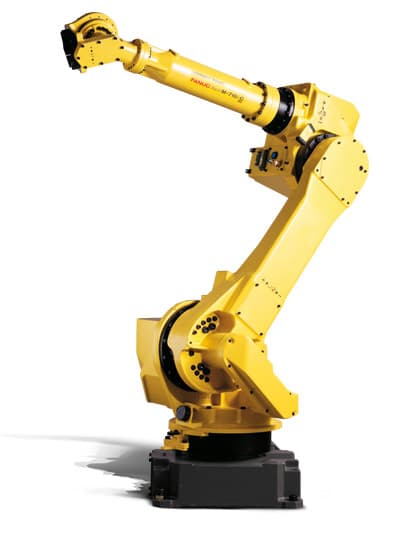
- FANUC M-710iC/50 (50kg / 2,050mm reach) — workhorse for palletizing and handling
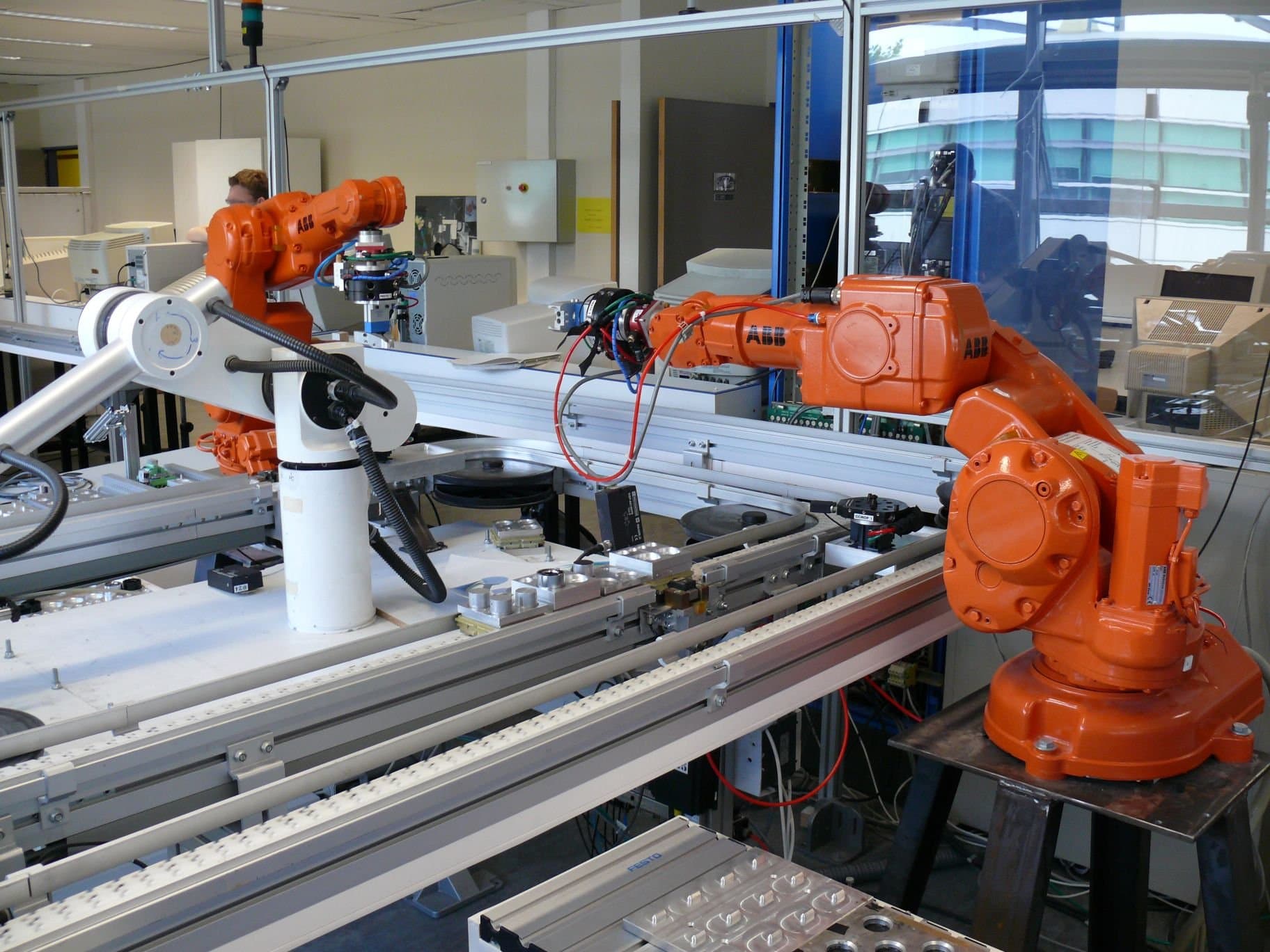
- ABB IRB 2600 (20kg / 1,650mm reach) — excellent for precision welding and assembly
- ABB IRB 4600 (60kg / 2,050mm reach) — direct FANUC M-710 competitor, superior path accuracy
- FANUC R-2000iC/210F (210kg / 2,655mm reach) — heavy palletizing
- ABB IRB 6700/235 (235kg / 2,650mm reach) — heavy palletizing, better inertia handling
Programming: TP vs RAPID
This is the most subjective difference — but it has real operational consequences. FANUC uses TP (Teach Pendant language), a line-numbered instruction set that is simple to learn but verbose for complex logic. ABB uses RAPID, a structured programming language closer to Pascal that is more powerful for complex algorithms but has a steeper learning curve.
Programming trade-offs:
- TP: faster to teach positions, easier for operators to understand and edit on the floor
- RAPID: better for complex branching, data structures, and reusable functions
- FANUC Karel: high-level compiled language for when TP is insufficient (file I/O, string handling)
- ABB RAPID modules: organize code into reusable modules — cleaner for large programs
- Offline programming: both support RoboGuide (FANUC) and RobotStudio (ABB) for simulation
Cobots: CRX Series vs GoFa / YuMi
Collaborative robots (cobots) are the fastest-growing segment. FANUC's CRX series and ABB's GoFa (CRB 15000) compete directly at the 5–25kg cobot range. Both are certified to work alongside humans without safety fencing (at reduced speeds, with proper risk assessment).
Cobot comparison:
- FANUC CRX-10iA: 10kg payload, 1,249mm reach, green LED safety indicator, IP67
- ABB GoFa 5 (CRB 15000): 5kg payload, 950mm reach, force sensing on every joint
- FANUC CRX-30iA: 30kg payload — heavy cobot, matched on the ABB side by the new PoWa 30
- ABB YuMi IRB 14000: 7-axis dual-arm, 0.5kg per arm — unique for small-part assembly
- Programming: FANUC CRX uses the same TP language; ABB GoFa uses full RAPID
Reliability and Maintenance
In our experience, both brands are exceptionally reliable when properly maintained. FANUC has a global reputation for the lowest failure rate in the industry — their robots are known to run for 20+ years with only scheduled maintenance. ABB matches this reliability in standard applications but historically has had more complex calibration requirements after repairs. FANUC spare parts are widely available in Israel; ABB parts typically require 24–72 hour import.
Xpert Robotics maintains a local spare parts inventory for both FANUC and ABB — with emergency response within 8 hours anywhere in Israel.
Which Brand to Choose: Our Recommendation
Choose FANUC when:
- You need maximum uptime and operator-maintainable programs
- The application is palletizing, material handling, or machine tending
- You want the lowest long-term parts and support cost in Israel
- You need a heavy cobot in the FANUC ecosystem (CRX-30iA, with 8-year maintenance-free cycle)
Choose ABB when:
- Path accuracy is critical — welding, dispensing, polishing
- You need complex software logic (RAPID is more powerful than TP)
- Small-part precision assembly — YuMi is unmatched for this niche
- Your engineering team has existing ABB RAPID expertise